
Achieving a healthy, attractive lawn doesn't require complicated strategies or endless products. Success comes down to mastering four fundamental practices: proper mowing, smart fertilization, timely aeration, and strategic overseeding. Get these basics right, and you'll have the green, thick turf you're after.
1. Mowing: The Most Important Practice
Mowing is the single most important factor in maintaining a healthy lawn. How you mow—and how often—directly impacts your turf's health, appearance, and ability to handle stress.
The One-Third Rule
Never remove more than one-third of the grass blade height in any single mowing. This isn't just a guideline—it's critical to grass health. When you cut off more than a third of the blade, you stress the plant, weaken its root system, and create openings for weeds and disease to take hold.
What this means in practice: If you're maintaining grass at 3 inches tall, you should mow when it reaches about 4.5 inches. If life gets busy and your lawn grows too tall, raise your mower deck and gradually bring the height back down over several mowings rather than scalping it all at once.
Mowing Height Matters
For cool-season grasses like bluegrass, ryegrass, and fescue, maintain a height between 2.5 and 3.5 inches. Taller is generally better, especially during summer heat.
Taller grass creates several important advantages:
Shades the soil surface, reducing water evaporation and keeping roots cooler
Develops deeper, stronger root systems that can access moisture and nutrients from lower soil layers
Crowds out weeds by blocking sunlight from reaching weed seeds at the soil surface
Better tolerates heat, drought, and foot traffic
During the hottest part of summer, consider raising your mowing height by another half inch to help grass cope with heat stress.
Mowing Frequency
Let grass growth dictate your mowing schedule, not the calendar. During peak growth periods in spring and fall, you might need to mow twice a week to maintain proper height without violating the one-third rule. During summer heat when growth slows, once every ten days to two weeks might be plenty.
The key is consistency—frequent enough that you're never removing excessive amounts at once, but not so frequent that you're mowing unnecessarily.
Sharp Blades Are Essential
Dull mower blades tear grass rather than cutting it cleanly. These ragged, torn edges turn brown, create entry points for disease organisms, and give your entire lawn a dull, unhealthy appearance. You can see the difference immediately—cleanly cut grass maintains its green color right to the tip, while torn grass shows brown, frayed edges.
Sharpen your mower blades at least twice per season—once in spring and again mid-summer. If you're mowing frequently or your lawn has a lot of rocks or debris, sharpen even more often.
Leave the Clippings
Unless your grass grew excessively tall or you're dealing with disease, leave grass clippings on the lawn. Clippings don't cause thatch buildup—that's a persistent myth. What they do provide is valuable nitrogen, returning about 25% of your lawn's annual nitrogen needs back to the soil as they decompose.
Bagging clippings removes these nutrients, creates unnecessary waste, and costs you time and money. The only times to remove clippings are when grass was cut too long and clumps remain, or when disease is present and you want to remove infected tissue.
2. Fertilization: Feeding at the Right Time
Fertilization does more to improve lawn quality than almost any other single practice. But timing matters enormously—feed at the wrong time and you can actually harm your lawn.
Fall: The Most Critical Application
Fall is hands-down the most important time to fertilize cool-season lawns. While spring fertilization pushes leaf growth, fall fertilization promotes root development, energy storage, and overall plant health going into winter.
Why fall fertilization matters:
Promotes deep root growth while soil is still warm
Builds carbohydrate reserves that fuel winter survival and early spring green-up
Thickens turf density without excessive top growth
Improves the lawn's ability to handle winter stress and recover quickly in spring
Apply approximately 1 to 1.5 pounds of actual nitrogen per 1,000 square feet in early September. A second application in late fall (late October or November) after growth has slowed provides additional benefit, helping grass enter winter with maximum stored energy.
Spring Fertilization: Proceed with Caution
Many homeowners over-fertilize in spring, pushing excessive leaf growth that actually weakens the grass. Spring-applied nitrogen stimulates rapid shoot growth that looks impressive initially but comes at the expense of root development. This creates grass that's vulnerable to summer heat, drought, and disease.
If your lawn greens up nicely on its own in spring, skip fertilization entirely. If you must fertilize in spring, wait until late spring (May), use a modest rate (0.5 to 1 pound of nitrogen per 1,000 square feet), and choose a slow-release product that won't force excessive growth.
Skip Summer Feeding
Summer heat already stresses cool-season grasses. Adding fertilizer during this stressful period forces growth the plant can't sustain, increases disease susceptibility, and can burn heat-stressed turf. Save your fertilizer dollars for fall when grass can actually use the nutrients productively.
The exception is intensively maintained, irrigated lawns where light summer feeding with slow-release products can maintain color without excessive stress.
Application Basics
Calculate your fertilizer needs based on the product's nitrogen content (the first number on the bag). If you're using a 20-5-10 fertilizer and want to apply 1 pound of nitrogen per 1,000 square feet, you'll need 5 pounds of product (1 pound nitrogen ÷ 0.20 = 5 pounds of product).
Apply fertilizer evenly using a broadcast spreader, making perpendicular passes to ensure uniform coverage. Sweep any fertilizer that lands on hard surfaces back onto grass to prevent it from washing into storm drains. Water lightly after application to move nutrients into the soil and off grass blades.
3. Aeration: Opening Up Compacted Soil
Over time, lawn soil becomes compacted from foot traffic, mowing equipment, and natural settling. Compacted soil restricts air, water, and nutrient movement to grass roots, essentially suffocating your lawn from below. Aeration breaks through this barrier.
Why Aeration Transforms Lawn Health
Core aeration removes plugs of soil from your lawn, creating channels that allow:
Oxygen to reach grass roots (roots need to breathe)
Water to penetrate deeply rather than running off
Fertilizer and nutrients to move into the root zone
Thatch to decompose naturally through improved microbial activity
On clay soils or high-traffic areas, aeration can make the difference between struggling, thin turf and thick, healthy grass. The improvement is often dramatic and immediate.
When to Aerate
The best time to aerate cool-season lawns is early fall—ideally late August through September. This timing allows grass to recover quickly while conditions favor active growth, and it creates perfect conditions for overseeding.
Early spring is your second-best option if you missed fall, but avoid aerating during summer heat or when grass is dormant.
Aerate when soil is moist but not saturated. If soil is bone dry, aeration equipment can't penetrate effectively. If it's muddy, you'll make a mess and potentially damage turf. The day after a good rain or irrigation is ideal.
The Right Equipment Matters
Use a core aerator (also called a plug aerator) that actually removes plugs of soil. These machines have hollow tines that pull cores out of the ground and deposit them on the surface.
Avoid spike aerators that simply poke holes in the ground. While they're cheaper and easier to use, spike aerators can actually increase compaction around the holes, defeating the purpose. If you're renting equipment or hiring a service, make sure you're getting true core aeration.
Make multiple passes over your lawn to achieve good coverage—aim for holes every 2-3 inches across the entire lawn surface.
After Aeration
The soil plugs left on your lawn's surface aren't attractive, but don't rush to remove them. These cores contain valuable soil and will break down naturally within a few weeks through rain, irrigation, and mowing. As they break down, they return that soil back to the lawn while the holes remain open.
You can speed the breakdown by mowing over the cores or raking them, but it's not necessary. They'll incorporate on their own.
4. Overseeding: Thickening Thin Turf
Even well-maintained lawns develop thin spots over time as individual grass plants die from stress, disease, or age. Overseeding introduces new grass plants, increases overall density, and allows you to incorporate improved, more disease-resistant grass varieties into older lawns.
Fall: The Ideal Overseeding Window
Late summer through early fall is by far the best time to overseed. The combination of warm soil (which promotes fast germination), cooling air temperatures (which reduce stress), and typically more reliable moisture creates ideal conditions for establishing new grass.
September is the sweet spot in most regions. Seeds germinate quickly in still-warm soil, new grass establishes before winter, and you avoid the weed competition that makes spring seeding challenging.
Combine Overseeding with Aeration
Overseeding works best when done immediately after core aeration. The holes created by aeration provide perfect seed-to-soil contact, protecting seeds and giving them an ideal microenvironment for germination. Seeds that fall into aeration holes have much higher germination rates than those sitting on the soil surface.
This is why early fall is such a powerful time—you can aerate and overseed in one efficient operation.
The Overseeding Process
Preparation: Mow your lawn shorter than normal (but don't scalp it) before overseeding. This reduces competition from existing grass and allows better seed-to-soil contact.
Aeration: Make multiple passes with a core aerator to create good hole coverage across the entire lawn.
Seeding: Apply grass seed using a broadcast spreader for even distribution. Use a quality seed blend appropriate for your region and conditions. Don't skimp on seed quality—improved varieties establish faster and perform better.
Coverage: Light raking can help work seed into aeration holes and ensure good contact, but it's not strictly necessary if you aerated thoroughly.
Water: This is the critical step. Keep the soil surface consistently moist (not saturated) until seeds germinate. This typically means light, frequent watering—sometimes twice daily in dry conditions—for the first two to three weeks. Once grass is established, transition to deeper, less frequent watering.
Patience: New grass takes time. You'll see germination in 7-21 days depending on grass type and conditions. Don't expect instant results, and avoid heavy traffic on newly seeded areas until grass is well-established.
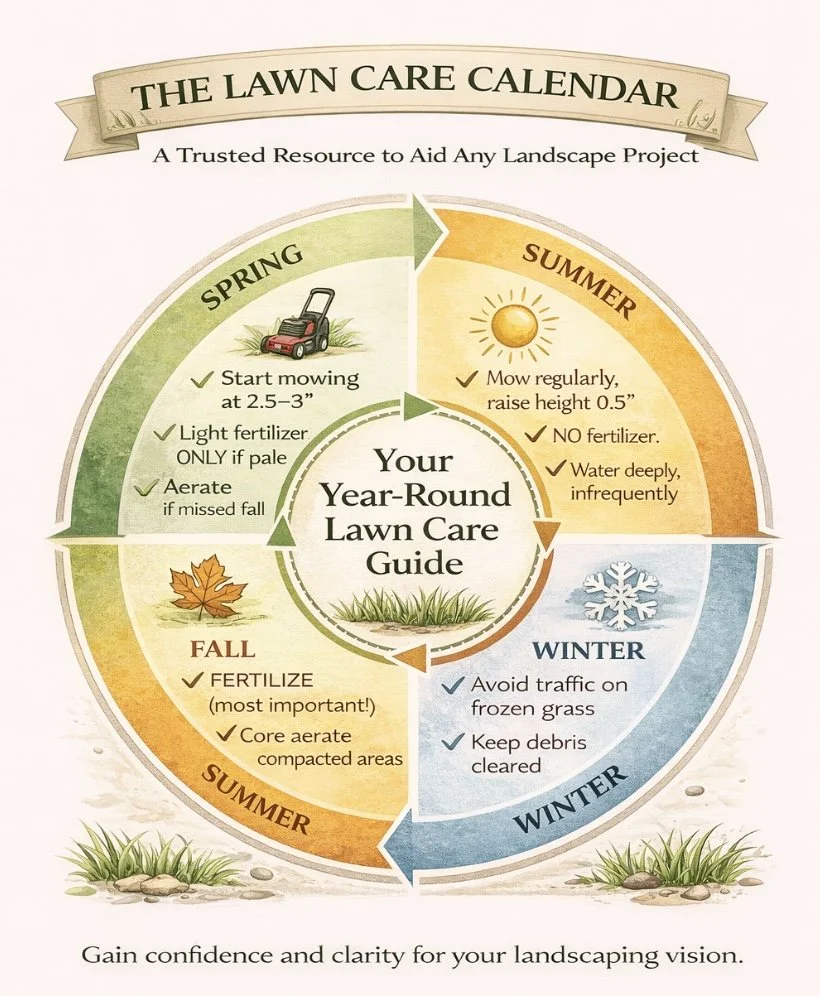
Putting It All Together: Your Annual Calendar
Spring (March-May):
Start mowing when grass begins active growth
Maintain 2.5-3 inch mowing height
Light fertilization only if lawn appears pale or weak
Aerate if you missed fall (early spring only, before heat)
Summer (June-August):
Continue regular mowing, adjusting frequency as growth slows
Raise mowing height by half an inch to help grass tolerate heat
Skip fertilization
Water deeply but infrequently if needed (1-1.5 inches per week total)
Fall (September-November):
Early September: Most important fertilization of the year
Early September: Core aerate compacted or thatchy areas
Immediately after aeration: Overseed thin areas
Late October/November: Second fertilization application
Continue mowing until growth stops for the season
Winter (December-February):
Keep lawn clear of heavy debris and snow piles
Avoid walking on frozen grass
Plan improvements for the coming year
The Foundation of Lawn Health
A thick, dense lawn naturally resists weeds, tolerates environmental stress, and maintains attractive appearance without excessive intervention. When you master these four essential practices, you create turf that doesn't need constant chemical treatments or emergency fixes.
The goal isn't perfection—it's healthy grass that serves your needs without consuming every weekend. Proper mowing maintains plant vigor. Well-timed fertilization builds strong roots and energy reserves. Core aeration opens compacted soil and allows grass to breathe. Overseeding fills thin areas and maintains density.
Together, these practices create genuinely healthy turf rather than just temporarily green grass. A lawn that receives these fundamental practices done correctly will outperform one receiving expensive treatments without this solid foundation.
Focus on getting the basics right before worrying about specialized products, premium treatments, or complex schedules. Master mowing height and frequency. Feed your lawn in fall when it matters most. Aerate compacted areas annually. Overseed to maintain thickness. Do these four things well, and you'll have a lawn that looks great and requires less overall effort than one managed haphazardly with expensive products.
Questions About Your Lawn?
Every lawn is different. Soil type, grass species, sun exposure, traffic patterns, and regional climate all influence what your specific turf needs. These fundamentals apply everywhere, but how you apply them to your particular situation can benefit from professional input.
Need help developing a management plan for your property? Whether you're dealing with persistent thin areas, determining the right fertilization schedule for your grass type, or wondering if your lawn would benefit from aeration, professional guidance ensures you're investing time and resources where they'll make the biggest difference.
Get personalized lawn care advice tailored to your property and goals.
