
Pruning is one of the most important—and most misunderstood—aspects of landscape maintenance. Prune at the wrong time, and you'll sacrifice a season of flowers, stress your plants, or invite disease. Prune correctly, and you promote healthy growth, abundant blooms, and strong plant structure.
The question isn't whether to prune, but when. Timing makes all the difference between helping and harming your plants.
This comprehensive guide breaks down exactly when to prune every type of plant in your landscape, why timing matters, and how to avoid the most common pruning mistakes.
Why Pruning Timing Matters
Plants operate on biological cycles tied to seasons, temperature, and day length. Pruning at the right time works with these natural rhythms. Pruning at the wrong time fights against them.
Proper timing ensures:
Maximum flowering - You don't cut off flower buds before they bloom
Reduced stress - Plants recover quickly when pruned during active growth periods
Disease prevention - Pruning when conditions favor wound closure minimizes infection risk
Controlled growth - Strategic timing directs energy where you want it
Winter hardiness - Avoiding late-season pruning prevents tender new growth before frost
Poor timing causes:
Lost blooms for an entire season
Weakened plants entering stressful periods
Increased disease susceptibility
Excessive suckering or unwanted regrowth
Winter damage to new growth
Understanding when each plant should be pruned transforms this essential task from risky guesswork into confident care.
The Golden Rules of Pruning Timing
Before we dive into specific plants, here are the fundamental principles that guide all pruning decisions:
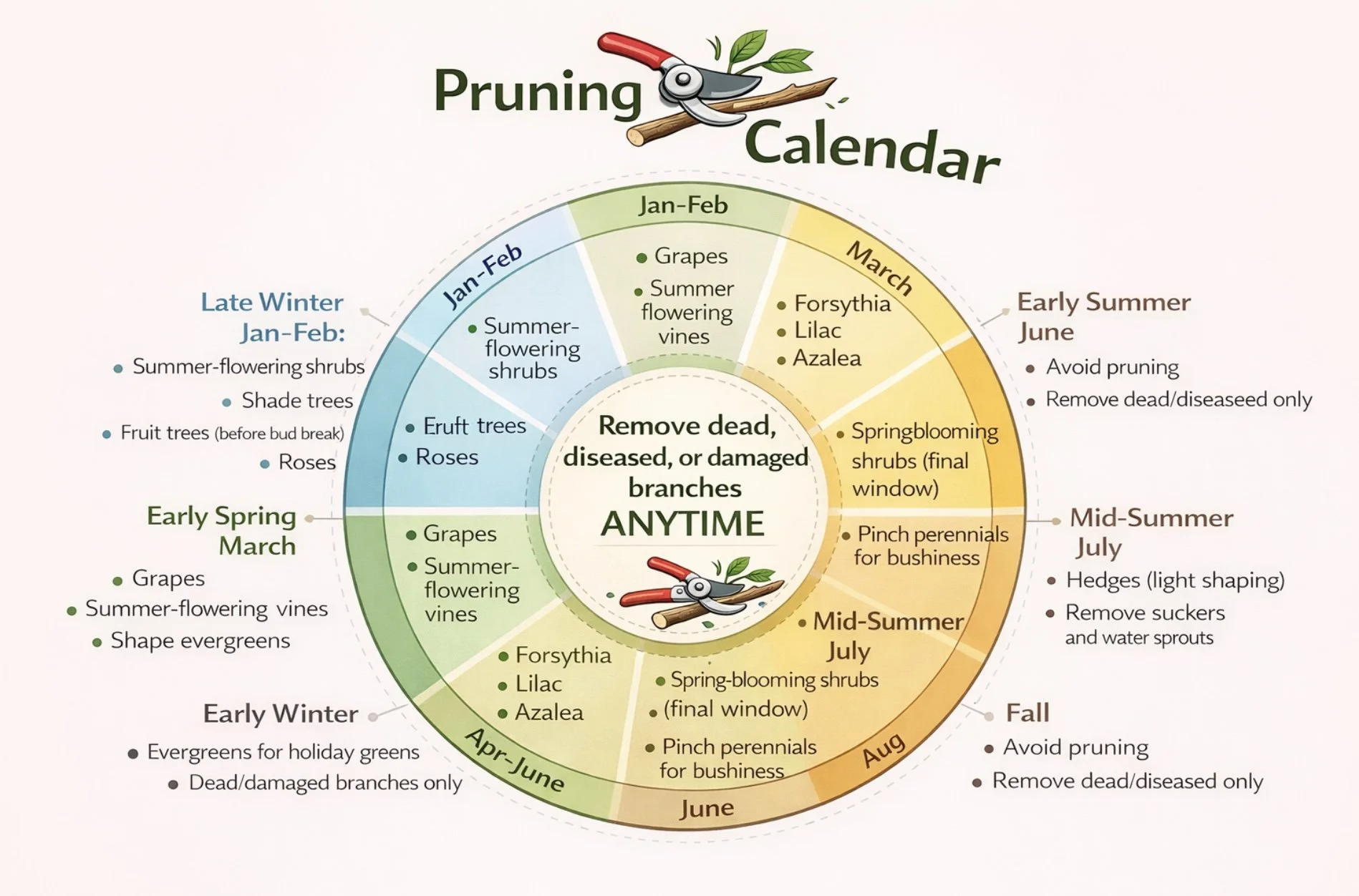
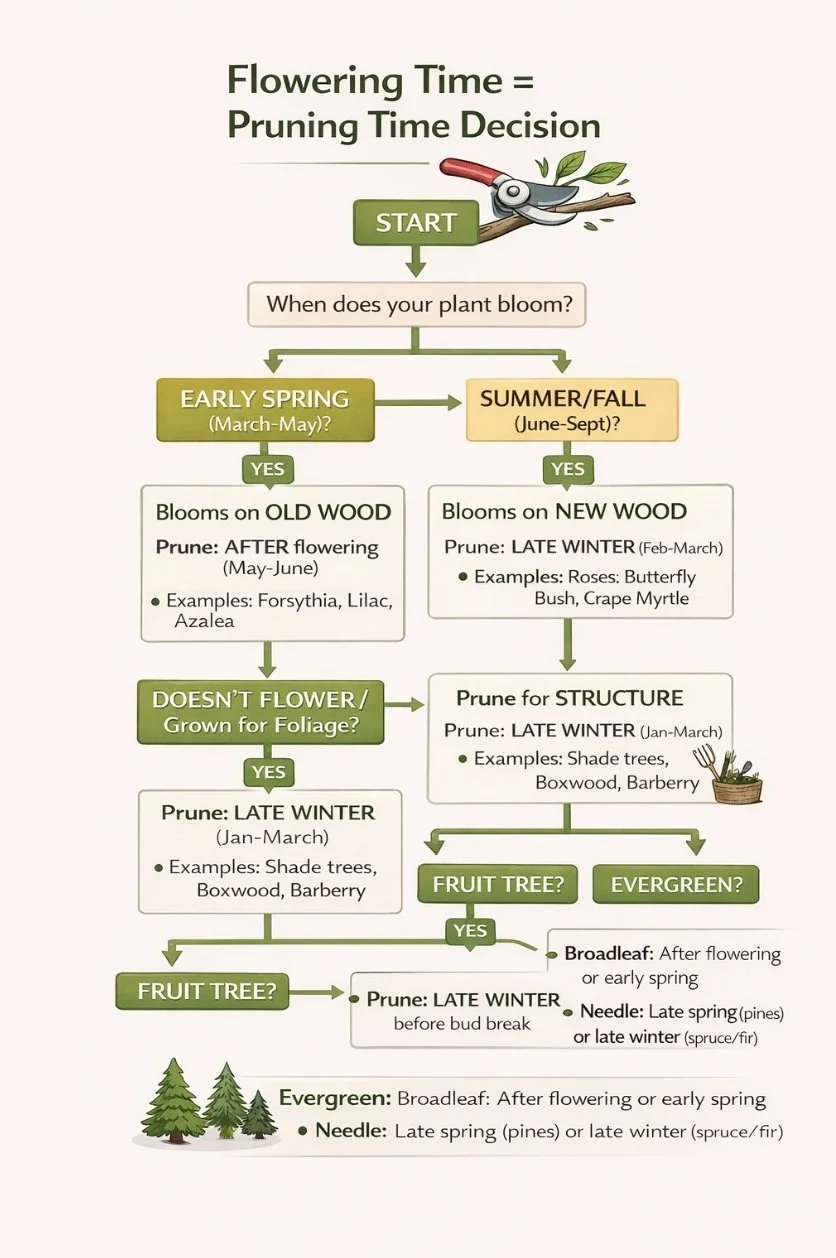
Rule #1: Prune Spring-Flowering Plants After They Bloom
Plants that flower in early spring (March-May) set their flower buds the previous summer and fall. If you prune them in late winter or early spring before flowering, you remove those buds and sacrifice that year's blooms.
Examples: Forsythia, lilac, azalea, rhododendron, flowering quince, magnolia
When to prune: Immediately after flowering finishes (typically late spring/early summer)
Rule #2: Prune Summer-Flowering Plants in Late Winter
Plants that flower in summer (June-September) develop flower buds on the current season's new growth. Pruning them in late winter or early spring removes old wood but leaves time for new flowering shoots to develop.
Examples: Butterfly bush, roses (most types), crape myrtle, hibiscus, hydrangea (some varieties)
When to prune: Late winter to early spring before new growth begins
Rule #3: Avoid Fall Pruning
Late summer and fall pruning stimulates new growth that won't harden off before winter, making plants vulnerable to cold damage. The only exception is removing dead, diseased, or damaged branches—that can happen anytime.
Why fall pruning is risky:
Triggers tender new growth that freezes
Reduces stored energy plants need for winter
Opens wounds that heal slowly in cooling temperatures
Can reduce cold hardiness
Rule #4: Prune for Structure in Late Winter
When you're pruning for plant structure, size control, or removing problem branches (not focused on flowering), late winter is ideal. Plants are dormant, the structure is visible without leaves, and wounds heal quickly when spring growth begins.
Best for: Shade trees, non-flowering shrubs, structural corrections
Pruning by Plant Type: A Detailed Guide
Spring-Flowering Shrubs
These plants bloom on "old wood"—branches that grew the previous season. They set flower buds in summer and fall for next spring's display.
When to Prune: Immediately after flowering (late spring to early summer)
Why: Gives plants maximum time to develop next year's flower buds on new growth. Waiting until fall or winter removes those buds.
Specific Plants and Timing:
Forsythia
Prune: Right after yellow flowers fade (April-May)
Method: Remove oldest stems at ground level, shape remaining growth
Avoid: Fall or winter pruning sacrifices next spring's bright yellow display
Lilac
Prune: Within 2 weeks of flowering finishing (late May-early June)
Method: Remove spent flower clusters, thin old stems, eliminate suckers
Avoid: Late pruning removes next year's buds; lilacs need time to set new ones
Azalea and Rhododendron
Prune: Immediately after blooming (May-June depending on variety)
Method: Light shaping, remove dead or leggy branches, pinch spent blooms
Avoid: These set buds early; prune late and you lose next spring's flowers
Flowering Quince
Prune: After flowering (April-May)
Method: Thin interior, remove old wood, shape as needed
Avoid: Winter pruning removes colorful early spring blooms
Magnolia
Prune: Right after flowering (late spring)
Method: Minimal pruning; remove only problem branches
Note: Magnolias compartmentalize wounds slowly—avoid large cuts
Avoid: Fall/winter pruning removes spring flower buds
Viburnum (spring-blooming varieties)
Prune: After flowering (May-June)
Method: Light shaping, thinning of old stems
Avoid: These bloom on old wood; late pruning sacrifices flowers
Weigela
Prune: After spring bloom (June)
Method: Remove up to 1/3 of oldest stems, shape lightly
Note: May rebloom lightly in summer
Avoid: Winter pruning removes spring flower buds
Summer-Flowering Shrubs
These plants flower on "new wood"—growth produced in the current season. Since flowers form on new shoots, you can prune before spring growth without sacrificing blooms.
When to Prune: Late winter to early spring (February-March)
Why: Removes old wood, stimulates vigorous new growth that produces flowers, and allows you to see plant structure clearly.
Specific Plants and Timing:
Butterfly Bush (Buddleia)
Prune: Late winter/early spring (February-March)
Method: Cut back hard to 12-18 inches; promotes vigorous flowering shoots
Why it works: Blooms on current season's growth; hard pruning = more flowers
Avoid: Light pruning creates tall, leggy plants with fewer flowers
Roses (Hybrid Tea, Floribunda, Grandiflora)
Prune: Late winter/early spring after last hard freeze
Method: Remove dead wood, thin center, cut healthy canes to outward-facing buds
Height: Varies by type (hybrid teas to 18-24", floribundas to 2-3 feet)
Avoid: Fall pruning stimulates tender growth that winter-kills
Crape Myrtle
Prune: Late winter (February-March in most regions)
Method: Remove suckers, thin crossing branches, shape as desired
Avoid "Crape Murder": Don't top trees into ugly stubs; selective thinning is better
Why late winter: Blooms on new growth; pruning stimulates flowering wood
Rose of Sharon (Hibiscus syriacus)
Prune: Late winter to early spring
Method: Shape, reduce size, thin interior
Why: Flowers on current season's growth
Avoid: Fall pruning reduces winter hardiness
Hydrangea (some varieties)
Smooth Hydrangea (H. arborescens 'Annabelle'): Prune hard in late winter; blooms on new wood
Panicle Hydrangea (H. paniculata): Prune in late winter; blooms on new wood
Bigleaf Hydrangea (H. macrophylla): Prune lightly after flowering; blooms on old wood
Oakleaf Hydrangea (H. quercifolia): Prune after flowering; blooms on old wood
Bluebeard (Caryopteris)
Prune: Early spring (March-April)
Method: Cut back to 6-12 inches
Why: Dies back in winter anyway; blooms on new growth
Avoid: Fall pruning offers no benefit; wait for spring
Shade Trees
Large deciduous trees benefit from structural pruning during dormancy when you can see branch architecture clearly and wounds heal quickly come spring.
When to Prune: Late winter (January-March) before bud break
Why: Structure is visible, sap flow hasn't started (less "bleeding"), wound closure begins immediately when growth resumes
Exceptions That Bleed Heavily (prune in summer instead):
Maples: Prune June-August to avoid excessive sap flow
Birches: Prune June-August to minimize bleeding
Walnuts: Prune summer; late winter pruning causes significant sap loss
Elms: Prune in winter BUT avoid April-June when elm bark beetles spread Dutch elm disease
General Shade Tree Pruning:
Remove dead, diseased, damaged branches anytime
Structural pruning: late winter
Light shaping and small branch removal: summer
Avoid: Fall pruning (reduces stored energy, opens wounds during decay-favorable conditions)
Evergreens
Evergreens have different growth patterns depending on whether they're needle or broadleaf types.
Needle Evergreens (Pine, Spruce, Fir):
When to Prune:
Pines: Late spring when "candles" (new growth) elongate but before needles expand fully
Spruce/Fir: Late winter to early spring before new growth, or midsummer after growth hardens
Method:
Remove dead branches anytime
Shape by removing branch tips (pines: break candles to control length)
Avoid cutting into old wood; most don't regenerate from bare stems
Yews and Junipers:
Prune: Late winter to early spring, or light shaping in summer
Can tolerate hard pruning into old wood (unlike pine/spruce)
Avoid: Fall pruning stimulates growth that may not harden before winter
Broadleaf Evergreens (Rhododendron, Holly, Boxwood):
When to Prune: After flowering (for flowering types) or early spring (for non-flowering)
Boxwood:
Prune: Late winter or after spring growth flush
Can shear multiple times during growing season for formal shapes
Avoid: Late summer/fall pruning
Holly:
Prune: Late winter or early spring
Can prune in early winter for holiday decorations
Light shaping anytime during growing season
Fruit Trees
Proper pruning timing is critical for fruit production, disease prevention, and tree structure.
When to Prune: Late winter (February-March) before bud break
Why:
See structure clearly
Wounds heal quickly when growth begins
Minimize disease spread (most pathogens dormant)
Doesn't remove developing fruit buds if done before swell
Specific Fruit Types:
Apples and Pears:
Prune: Late winter (February-March)
Focus: Open center, remove crossing branches, thin fruiting spurs
Summer pruning (optional): Light thinning in July to control vigor
Peaches, Nectarines, Apricots:
Prune: Late winter, but AFTER worst cold passes
These are more cold-sensitive; pruning too early reduces winter hardiness
Focus: Open vase shape, thin heavily (peaches fruit on previous year's wood)
Cherries:
Prune: Late winter for sweet cherries
Late summer for sour cherries (reduces bacterial canker risk)
Grapes:
Prune: Late winter to early spring while fully dormant
Heavy pruning required; grapes fruit on current season's growth from previous year's canes
Bleeding is normal if pruned late; doesn't harm vines
Blueberries:
Prune: Late winter (February-March)
Remove oldest stems, thin weak growth, keep vigorous 1-3 year old canes
Fruit on previous year's growth
Perennials
Herbaceous perennials have different pruning needs than woody plants.
Spring-Blooming Perennials:
Cut back dead foliage: Early spring before new growth
Divide: Fall (after flowering) or early spring
Summer/Fall-Blooming Perennials:
Cut back dead foliage: Late fall or early spring
Pinch for bushiness: Late spring/early summer (remove top 1-2" to encourage branching)
Deadhead spent blooms: Throughout season for continued flowering
Divide: Spring before growth begins
Ornamental Grasses:
Cut back: Late winter/early spring before new growth
Leave standing through winter for structure and wildlife value
Avoid: Fall cutting removes winter interest
Vines
Vine pruning timing depends on flowering period and growth habit.
Spring-Flowering Vines (Wisteria, Clematis - spring types):
Prune: After flowering
Light shaping and removal of spent blooms
Summer-Flowering Vines (Clematis - summer types, Trumpet Vine):
Prune: Late winter/early spring
Blooms on current season's growth
Climbing Roses:
Prune: Early spring
Remove dead canes, thin crowded growth, tie up new growth
Grapevines:
Prune: Late winter while dormant
Heavy pruning required annually
Common Pruning Mistakes and How to Avoid Them
Mistake #1: Pruning Spring Bloomers in Winter
The Problem: You remove all the flower buds before they open
The Fix: Wait until after flowering. Mark your calendar after plants bloom as a reminder for next year
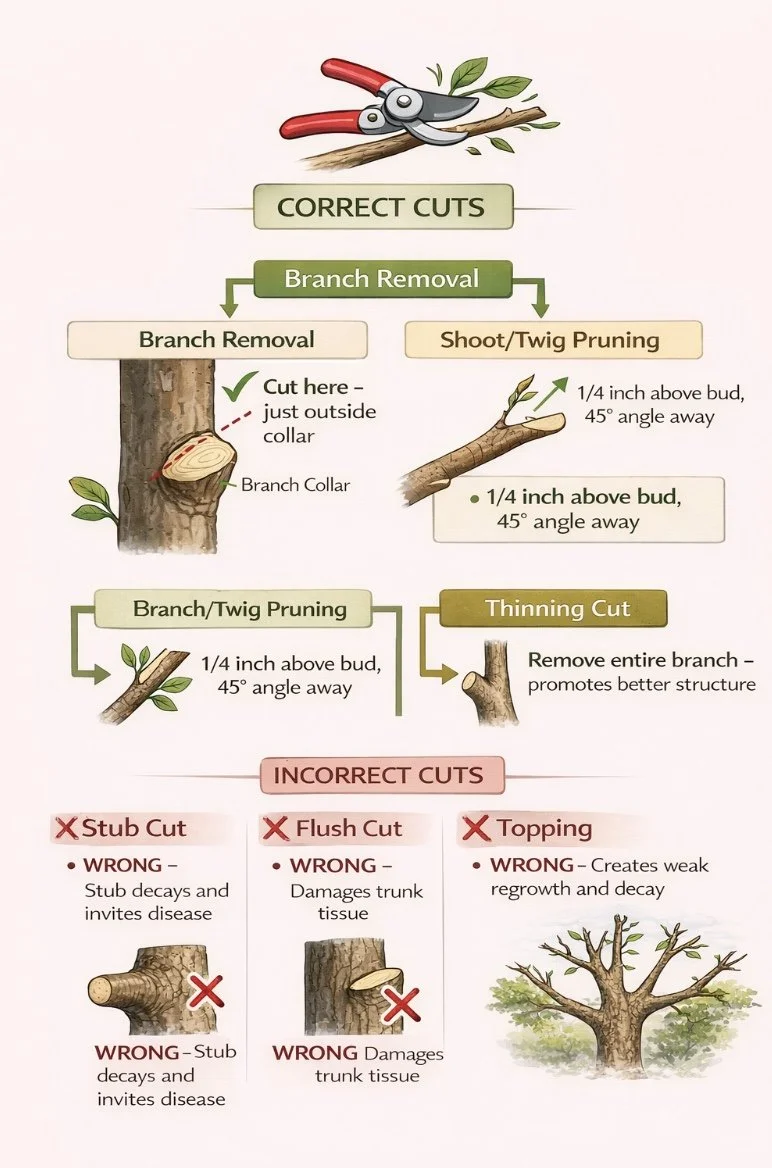
Mistake #2: "Topping" Trees
The Problem: Cutting main trunks or branches to stubs creates weak regrowth, decay, and ugly form
The Fix: Use selective thinning instead. Remove entire branches back to the trunk or a lateral branch
Mistake #3: Pruning in Fall
The Problem: Stimulates new growth that won't harden before winter
The Fix: Wait until late winter for major pruning. Only remove dead/diseased/damaged in fall
Mistake #4: Removing Too Much at Once
The Problem: Stresses plants, reduces food production, triggers excessive regrowth
The Fix: Never remove more than 1/3 of plant in a single year. Spread major renovation over 2-3 years
Mistake #5: Pruning Too Close or Too Far from Buds/Branches
The Problem: Cuts too close damage remaining tissue; cuts too far leave stubs that decay
The Fix:
On branches: Cut just outside the branch collar (swollen area where branch meets trunk)
On shoots: Cut 1/4" above an outward-facing bud at 45° angle
Mistake #6: Using Dull Tools
The Problem: Ragged cuts heal slowly and invite disease
The Fix: Sharpen pruners, loppers, and saws regularly. Clean cuts heal faster
Mistake #7: Not Disinfecting Tools Between Plants
The Problem: Spreads disease from infected to healthy plants
The Fix: Wipe blades with rubbing alcohol or 10% bleach solution between plants, especially if disease is present
Special Considerations
Newly Planted Trees and Shrubs
When to Prune: Minimal pruning at planting
What to Remove:
Dead, broken, or damaged branches only
Crossing or rubbing branches
What NOT to do:
Don't remove lower branches to "force upward growth"
Don't "balance" top to root size (leaves produce food for root development)
Don't prune healthy branches for 1-2 years (let plant establish)
Renovation Pruning (Overgrown Shrubs)
When: Late winter for most shrubs
Method:
Option 1 (Gradual): Remove 1/3 of oldest stems at ground level each year for 3 years
Option 2 (Aggressive): Cut entire shrub to 6-12 inches in late winter (works for forsythia, lilac, privet, spirea - NOT all plants tolerate this)
Plants that tolerate hard renovation: Forsythia, privet, spirea, burning bush, most viburnums
Plants that DON'T tolerate hard pruning: Most needle evergreens, magnolia, Japanese maple
Storm Damage Pruning
When: Immediately for safety; cleanly remove broken branches anytime
Method:
Remove hazardous branches immediately
Clean up ragged breaks with proper cuts
Save structural pruning for proper season if possible
Deadheading Flowers
When: Throughout blooming season
Purpose:
Promotes continued flowering
Prevents energy waste on seed production
Improves appearance
Method:
Remove spent blooms just above next leaf or bud
Some plants (roses) benefit from cutting back to 5-leaflet leaf
Some plants (coneflowers, rudbeckia) can be left for bird food and winter interest
Regional Timing Adjustments
Pruning timing varies by climate zone. The principles remain the same, but calendar dates shift.
Cold Climates (Zones 3-5):
Late winter pruning: March-April
After-bloom pruning: June-July
Last pruning date: Mid-July (to allow hardening before frost)
Moderate Climates (Zones 6-7):
Late winter pruning: February-March
After-bloom pruning: May-June
Last pruning date: Late July to early August
Warm Climates (Zones 8-10):
Late winter pruning: January-February
After-bloom pruning: April-May
Can prune later into season due to extended growing period
General Rule: Adjust based on your last frost date and first frost date. "Late winter" means 4-6 weeks before last frost. "After bloom" means as soon as flowers fade.
Tools for Proper Pruning
Having the right tool for the job makes pruning easier, safer, and produces better results.
Hand Pruners (Bypass type):
For: Stems up to 3/4" diameter
Best for: Detailed work, flower removal, small branches
Loppers:
For: Branches 3/4" to 2" diameter
Best for: Larger shrub branches, small tree limbs
Pruning Saw:
For: Branches over 2" diameter
Best for: Large limbs, tree pruning
Hedge Shears:
For: Formal hedges, shaping
Best for: Shearing multiple small stems at once
Pole Pruner:
For: High branches without ladder
Best for: Overhead branches within reach
Tool Maintenance:
Sharpen regularly (dull tools damage plants)
Clean after each use
Disinfect between plants (especially if disease present)
Oil moving parts
When NOT to Prune
Sometimes the best pruning decision is to wait.
Avoid Pruning When:
Fall (September-November):
Stimulates growth that won't harden before winter
Exception: Removing dead/diseased/damaged branches
During Active Blooming:
Interrupts flower display
Exception: Deadheading to promote more blooms
During Extreme Stress:
Drought conditions
Heat waves
After transplanting (wait 1 year)
When Disease is Spreading:
Wait until dry weather if possible (reduces disease spread)
If removal is necessary, disinfect tools after every cut
When Trees are "Bleeding":
Maples, birches, walnuts bleed sap heavily if pruned in late winter/early spring
Not harmful to tree, but messy
Prune these in summer instead
The Bottom Line: Match Timing to Plant Type
Successful pruning isn't complicated once you understand one key principle: match your pruning timing to how and when the plant produces flowers.
Spring bloomers: Prune after flowering
Summer bloomers: Prune in late winter
Non-flowering plants: Prune in late winter for structure
Fruit trees: Prune in late winter before bud break
Evergreens: Varies by type, but generally late winter or after new growth
When in doubt, remember: you can always remove dead, diseased, or damaged branches anytime. For everything else, late winter is a safe default for most plants, with the notable exception of spring-flowering shrubs.
Your Pruning Questions Answered
Pruning can feel intimidating, especially when timing matters so much. Understanding your specific plants' needs, recognizing problems early, and knowing when to intervene (and when to wait) separates successful pruning from frustrating mistakes.
Have questions about when to prune specific plants in your landscape? Whether you need help identifying what you have, determining the right pruning schedule, or learning proper techniques, professional guidance ensures you're enhancing your plants' health and beauty rather than accidentally harming them.
Get expert pruning advice tailored to your landscape and your region.
